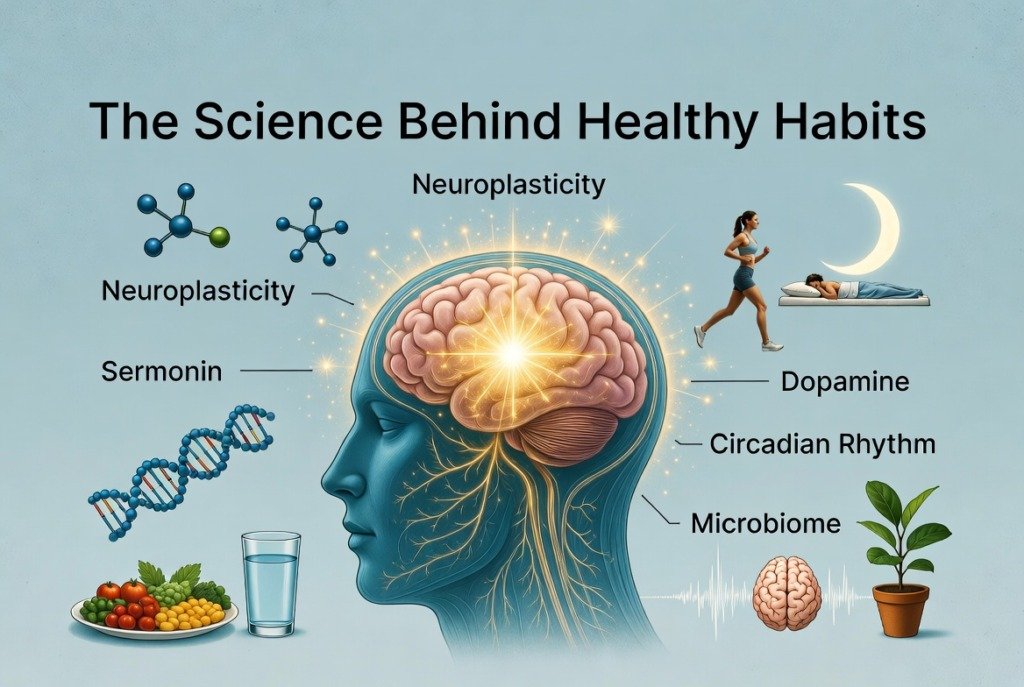
The Science Behind Healthy Habits
It is a common issue that everyone finds it hard to get rid of unhealthy habits. Because they don’t know the science behind healthy habits. Here is how you can cope with it by knowing the science of habits.
How are habits built?
Healthy habits and bad ones are built through a repeating neurological cycle called Habit loop.
It consists of 3 steps:
- Cue: A trigger that starts a behavior.
- Routine: The actual action or habit you do.
- Reward: The positive result that makes you want to repeat it.
For instance:
You realized that whenever you feel bored, you start scrolling phone reels.
So here, boredom is the cue (the trigger) that starts the routine (the habit of scrolling reels), and the reward (feeling pleasure that spikes dopamine) lets your brain know that this loop works and makes you repeat it.
Over time, the habit strengthens, and this information is transferred into basal ganglia (a group of structures deep inside the brain that control habits and learning), causing the action to shift into automation. In this way, the brain doesn’t think when the same cue occurs. It just automates the usual reaction.
That’s why everyone finds it challenging to change their habits.
Breaking Bad habits:
You cannot do this in a short time, but by merging these habits with the new and good ones, it is possible to eradicate them effectively. Whenever we try new things, our brain builds new neural pathways for it, and by doing it consistently these pathways strengthen. By this, you wouldn’t face any difficulty in adapting a new habit. This is an effective use of neuroplasticity (the brain’s remarkable capacity to adapt).
Applying it to the previous case, we can comprehend it as whenever you feel bored, try reading a book, but if you just want to completely do it. It would be difficult. So, merge this new idea with the previous habit (use phone to comply with the habit but also read a book for some time). By doing this, your brain will make a new neural pathway and if you continue to do it daily (by lessening the time to use phone and increasing the time to read a book gradually). You would definitely triumph over it.
Challenges and Risks:
- Myth of 21 days:
Real habit formation takes 2–5 months, not 3 weeks.
- Instant gratification trap:
Unhealthy habits (junk food, scrolling) are reinforced faster because rewards are immediate.
- Environmental influence:
Habits are shaped by cues—changing surroundings can make or break routines.
Deep Science Behind Healthy Habits:
| Concept | Mechanism | Impact |
| Repetition | Strengthens neural pathways | Makes actions automatic |
| Reward system | Dopamine release | Reinforces behavior |
| Neuroplasticity | Brain rewiring | Enables habit change |
| Decision fatigue reduction | Automates routine choices | Conserves mental energy |
| Compounding effect | Small gains accumulate | Long-term exponential growth |
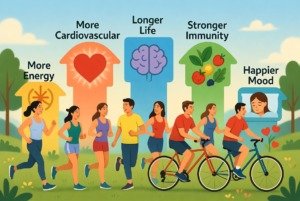
Examples of Detailed Science Behind Healthy Habits:
Example 1: Regular Exercise
Exercise is one of the most powerful healthy habits. When you engage in consistent physical activity, your body undergoes several physiological changes:
- Endorphins: These “feel‑good” neurotransmitters reduce pain perception and elevate mood, explaining the “runner’s high.”
- Neurogenesis: Exercise stimulates the growth of new neurons in the hippocampus, improving memory and learning.
- Cardiovascular health: Aerobic activity strengthens the heart muscle, lowers blood pressure, and improves circulation.
- Metabolic regulation: Exercise increases insulin sensitivity, reducing the risk of type 2 diabetes.
Science shows that just 30 minutes of moderate exercise daily can lower all‑cause mortality risk by up to 30%.
Example 2: Balanced Nutrition
Healthy eating habits—like consuming whole grains, fruits, vegetables, and lean proteins—work at the cellular level:
- Micronutrients: Vitamins and minerals act as cofactors in enzymatic reactions, supporting immunity and energy metabolism.
- Fiber: Dietary fiber feeds gut microbiota, producing short‑chain fatty acids that reduce inflammation and improve digestion.
- Blood sugar regulation: Complex carbohydrates release glucose slowly, preventing spikes that damage blood vessels.
- Antioxidants: Found in colorful fruits and vegetables, they neutralize free radicals, lowering cancer risk.
Nutrition science emphasizes the “Mediterranean diet” as a model, linked to reduced cardiovascular disease and improved longevity.
Example 3: Consistent Sleep
Sleep is not passive—it is an active biological process essential for health:
- Memory consolidation: During deep sleep, the brain strengthens synaptic connections, improving learning.
- Hormonal balance: Sleep regulates cortisol (stress hormone) and growth hormone, critical for tissue repair.
- Immune function: Sleep enhances production of cytokines, proteins that fight infection.
- Glymphatic system: Sleep clears metabolic waste from the brain, reducing risk of neurodegenerative diseases.
Adults who consistently sleep 7–9 hours show better cognitive performance and lower risk of obesity and heart disease.
Example 4: Mindfulness & Stress Management
Practicing mindfulness or meditation rewires the brain:
- Amygdala regulation: Meditation reduces activity in the amygdala, lowering anxiety responses.
- Prefrontal cortex strengthening: Improves focus, decision‑making, and emotional regulation.
- Cortisol reduction: Regular mindfulness lowers chronic stress hormone levels, protecting cardiovascular health.
Studies show that just 10 minutes of daily mindfulness can reduce perceived stress and improve resilience.
Takeaway:
The Science Behind Healthy habits is not about discipline alone. They are about how your brain and body work. When practiced consistently, these habits create a feedback loop (the continuous cycle where an action leads to a result, and that result teaches your brain whether to repeat the behavior).
Caption:
By understanding the science behind healthy habits, you can adopt a healthy habit you want with little effort. So, start applying it today by stepping out of your comfort zone- because by doing this, your actions lead to effective results.