Let’s be honest about something.
Finding a remote job that actually hires from anywhere is tough. Not impossible. But tough.
I’ve spent hours scrolling through job boards, getting excited about a “remote” position only to find out at the bottom of the description that they only want candidates from the US or UK. It’s frustrating and heavy. It feels like you’re being told “you can work from anywhere… just not where you are.”
But here’s the thing. It’s not impossible. It’s just that most people don’t know how to research and search properly.
So let me tell you what actually works.
The Problem With Most Remote Job Searches
Most job boards don’t care where you’re applying from. They’ll happily show you remote roles that say “Remote” in the title. Then you scroll down and see the catch: “Must be authorized to work in the United States” or “Only candidates based in Europe.”
This happens all the time. And it wastes hours of your life.
But there’s a way around it.
The LinkedIn Strategy That Changes Everything
LinkedIn is still the best tool for finding remote work. But you have to use it the right way.
Here’s what most people do wrong: they search for “remote jobs” and click on whatever comes up. Then they spend hours applying to jobs they’ll never get because they live in the wrong country.
Use the Right Filters
When you’re searching on LinkedIn, don’t just type “remote.” Do this instead:
Search your keyword (like “content writer” or “data analyst” or “marketing manager” or “video editor”). Then click on “Jobs.” Now filter by location. But here’s the trick: don’t pick a city. Pick a whole country.
So instead of typing “New York,” type “United States.” Then filter by “Remote.”
Why does this matter? Because if a job says “United States (Remote)” it might hire globally. But if it says “New York, NY (Remote)” it probably won’t.
It’s a small difference in how you search. But it makes a huge impact in what you find.
Set Up Alerts for Your Target Companies
Here’s something most people don’t know: jobs often appear on company career pages before they show up on job boards.
That means if you’re only checking LinkedIn’s job board, you’re already late.
So instead of setting alerts for keywords, set alerts for companies you actually want to work for. Follow them on LinkedIn. Turn on your notifications. When they post a job, you’ll know immediately.
Find the Right People
Applying through a job portal is like throwing your resume into a black hole. You never know if anyone actually reads it.
But reaching out to real people? That’s different.
Use LinkedIn to search for recruiters or hiring managers at companies you’re interested in. Look for titles like “Technical Recruiter,” “Talent Acquisition,” or “[Industry] Hiring Manager.” Then filter it by location to find people in the countries you want to work with.
Here’s the thing though. Don’t just send a connection request saying “I want a job.” That doesn’t work.
Instead, engage with their content first. Like their posts. Leave thoughtful comments. Share your own updates about your skills and projects. Let them see your name and know your skills before you ever ask for anything.
Then when you do reach out, keep it simple. Something like:
“Hi [Name], I saw you’re recruiting for [specific field]. I’d love to connect and learn more about opportunities in [your domain].”
That’s it. No essay. No desperate plea. Just a human being talking to another human being.
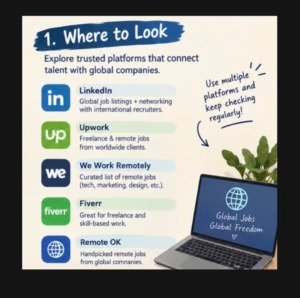
Where to Find Jobs That Actually Hire Globally
LinkedIn is great, but it’s not the only place. There are job boards specifically built for remote-first companies that hire internationally.
Here are the ones that actually work:
WeWorkRemotely.com – One of the oldest remote job boards. You can filter by timezone, which is actually useful because a job that expects you to be online at 9 AM Eastern Time is going to be rough if you’re in Pakistan.
Remotive.io – Great for tech, product, marketing, and writing roles. Lots of companies that are used to hiring internationally.
FlexJobs.com – This one costs money, but it’s worth it if you’re serious. They curate jobs and screen out the scams.
OysterHR.com/careers – These are companies that hire through Oyster, which is a global HR platform. If they’re listed there, they hire globally.
There are others too. But these are the ones that consistently have real international remote roles.
How to Read Between the Lines
This is important. Some job descriptions say “remote” when they actually mean “remote within a specific country.” How can you read between the lines?
So look for these phrases:
Green flags (good signs):
- “Work from anywhere”
- “Open to candidates worldwide”
- “Location independent”
- “Global team”
Red flags (warning signs):
- “Must work Eastern Time hours” – tough if you’re 6+ hours ahead
- “Only accepting applicants with US work authorization”
- “We cannot sponsor visas” – this usually means you need to already live in that country
Read the full description. Every time. It saves you from wasting hours on applications that were never going to work for you.
LinkedIn: More Than Just Job Applications
LinkedIn isn’t just a place to apply for jobs. It’s a place to build relationships.
Here’s what most people miss: LinkedIn is a networking platform first and a job board second.
That means your profile matters. A lot.
If your profile looks empty or unprofessional, nobody’s going to take you seriously. But if you show your skills, your projects, your wins, and your personality, people will notice.
A few things that actually help:
Post about your work. Not just when you get a new job, but when you finish a project, learn a new skill, or solve a problem. Show people what you can do.
Connect with people in your industry. Not to ask for jobs. Just to learn from them. Engage with their content. Build real relationships.
Make your profile global-friendly. If you want to work with international companies, show that you can. Mention your ability to work across time zones, your communication skills, your experience working with remote teams.
LinkedIn Premium is optional. Some people find the InMail credits useful. Some find the “who viewed your profile” feature helpful. But you don’t need to pay to get value from LinkedIn. A strong profile and consistent engagement matter more than just the subscription.
Instagram: The Unexpected Job Search Tool
Okay, this one might surprise you.
Instagram isn’t a job board. You can’t search for jobs there. But that doesn’t mean it’s useless.
Here’s how to use it: Follow companies you want to work for.
Most companies have Instagram pages. They share behind-the-scenes content, team updates, and sometimes even job postings. By following them, you get a feel for their culture. You see what they care about. You understand what kind of people they hire.
And when you eventually apply or reach out, you’ll already know something about them. That makes a difference.
You can also interact with their posts. Like their content. Leave comments. Show genuine interest. It’s not about asking for a job. It’s about being present.
One important note though: Instagram is a personal platform. Most recruiters don’t want to be contacted there for job opportunities. So keep it professional. Use it for research and engagement, not for cold messages asking for work.
The Scam Problem (And How to Spot It)
I have to talk about this because it’s important.
Remote job scams are everywhere. And they’re getting more convincing and attractive.
Here’s the pattern: You get a message from someone claiming to be a recruiter. They offer you a remote job with high pay and flexible hours. They ask you to move the conversation to WhatsApp or Telegram. Then they ask you to pay for “training” or “equipment” or “software.”
Real employers never ask you to pay for anything. Not for training. Not for equipment. Not for background checks. Nothing.
Other red flags:
- They ask for your personal information (bank details, ID, etc.) before you’ve even interviewed
- They offer high pay for very little work
- They create urgency – “only 5 positions available”
- They contact you via text message or encrypted apps instead of professional email
If something feels off, trust your sixth sense. Look up the company. Look up the recruiter’s name. Search for the company name plus “scam” or “complaint”.
Your time is valuable and important. Don’t waste it on people who are trying to take advantage of you.
What Actually Works
Let me summarize this in the simplest way possible.
Search smart. Use the right filters on LinkedIn. Look for “worldwide” or “global” in job descriptions. Avoid anything that specifies a country you don’t live in.
Go to the source. Check company career pages directly. Follow companies on LinkedIn. Engage with recruiters before you need them.
Use the right job boards. WeWorkRemotely, Remotive, FlexJobs, Oyster. These are built for international remote work.
Build your presence. LinkedIn is your professional home. Keep it updated. Post about your work. Connect with people. Show that you’re someone worth hiring.
Be patient. Finding an international remote job takes time. It’s a numbers game. Apply consistently. Network consistently. Don’t give up after ten applications.

A Final Thought about Remote jobs
The remote job market is growing rapidly. Companies around the world are realizing that talent doesn’t have borders. They’re hiring people from everywhere because they want the best people, not just the ones who happen to live nearby.
But that doesn’t mean it’s easy. It takes strategy. It takes patience. It takes showing up every day and doing the work.
You don’t need to be lucky. You just need to be smart about how you search and show your skills.
And honestly? The fact that you’re reading this means you’re already ahead of most people.
Keep going.
- What’s been your experience with finding remote jobs? Have you found any strategies that work? Share in the comments and let’s help each other out.