
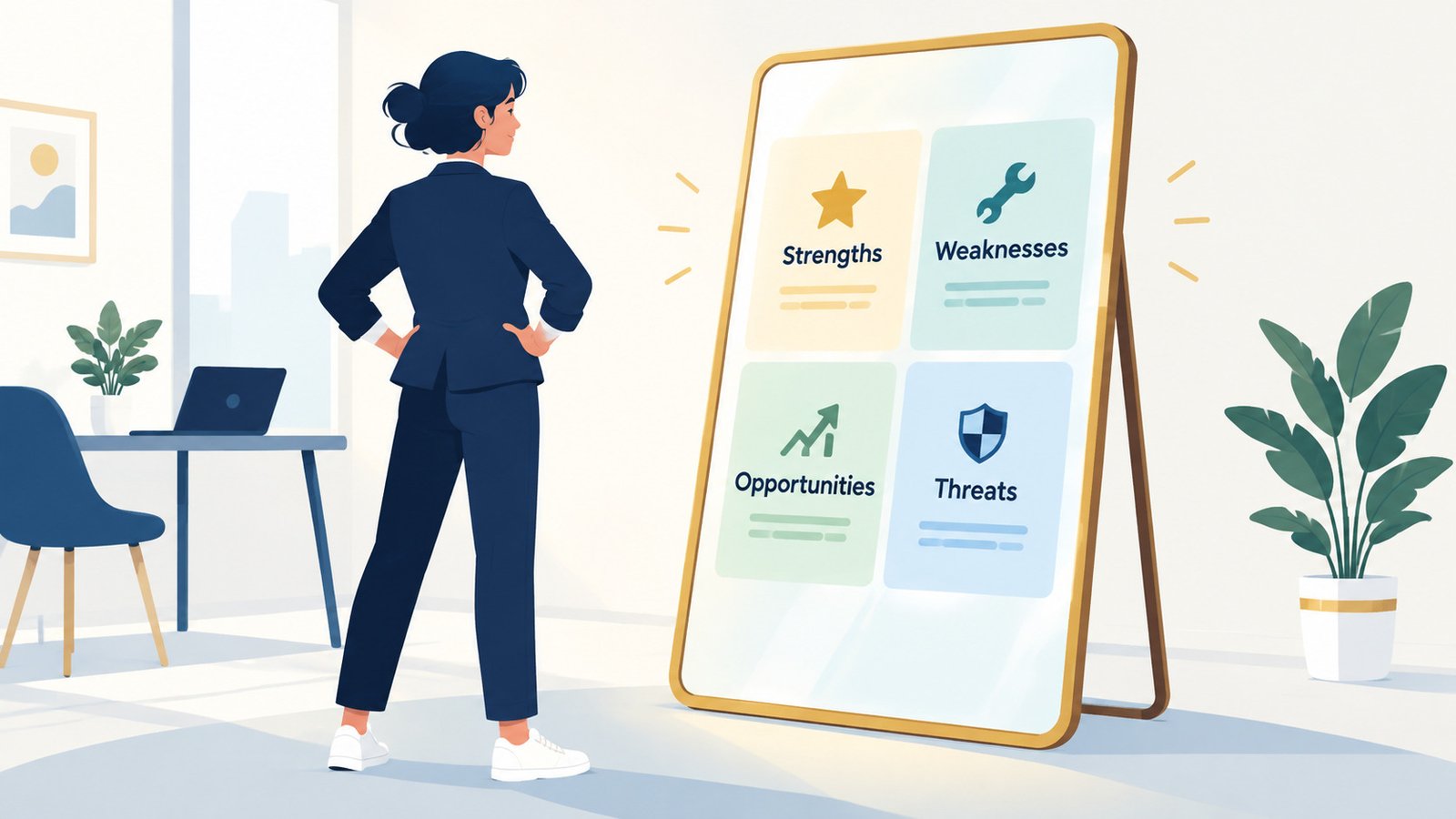
Personal SWOT Analysis for Career Growth
Choosing a career direction can be really challenging, right?
You may be deciding to pursue further education, applying for a new role, or developing a skill. A personal SWOT analysis is the simplest practical method to make such decisions with greater clarity. It helps you evaluate your qualities in the environment you have, which may influence your professional future.
SWOT stands for:
- Strengths
- Weaknesses
- Opportunities
- Threats
Although organizations commonly use this analysis for strategic planning, individuals can apply it to their career enhancement. It provides an organized way to assess where you are now, what you need to improve, and which career opportunities will most suit you.
Understanding the Four Areas
Starting with the ‘Strengths’, these are the internal qualities that give you an advantage. These may include your education, professional experiences, communication abilities, technical skills, leadership qualities, and a strong professional network. For instance, a pharmacy graduate may have strengths in laboratory work, research writing, medication expertise, patient counselling, and regulatory awareness.
‘Weaknesses’ are internal areas that may hinder your progress. They are not permanent failures; rather, they are areas that need development. Examples include poor time management, lack of confidence, weak social skills, insufficient technical knowledge, and incompetence in using specialized software. Identifying your weak points allows you to create an improvement plan.
‘Opportunities’ are external factors that can assist your career development. These may include training programmes, networking events, scholarships, internships, research projects, professional workshops, and online certification courses. Opportunities often become more significant when you actively research your chosen profession and engage with professionals in that field.
‘Threats’ are mainly external risks such as economic slowdown, oversaturated fields, or any personal circumstances that limit your opportunities. For example, someone entering graphic design today should also know that AI tools are automating routine design work. Any threat, once acknowledged, becomes a strategy. So, a designer should move towards designs that require human judgement and less AI.
Connect the Four Quadrants
The real meaning comes forward when you cross-reference the quadrants. Ask yourself four questions:
- How can I use my strengths to avail opportunities I found?
- Which weakness of mine could block these opportunities? And can I fix them?
- How can my strengths help reduce my threats?
- And which threats target my weaknesses directly?
The last combination is the most important takeaway. If a real threat from outside affects one of your weaknesses inside you, that is exactly what you need to work on first.
How to Create Your Personal SWOT Analysis for Career
Start your analysis by defining a specific career decision. Instead of thinking, “What should I do in life?” ask a focused question like, “Should I apply for a master’s programme?” or “Should I seek an entry-level research position?”
On a blank sheet of paper, draw four sections: strengths, weaknesses, opportunities, and threats. Write down or outline your core points using the questions above, as part of connecting strategy for SWOT. Use your evidence alongside this exercise. For example, write “I participated in a research poster presentation” rather than simply stating “I have experience in research”. Be specific.
After completing the table, look for the connection between all the sections. Evaluate how your strengths can help you benefit from opportunities. Identify which weakness needs your priority. See how your strengths (networks, qualifications, skills, experiences) can reduce your threats.
Is it Self-Criticism or Self-Discovery?
We may find ourselves being a critic when jotting down our weaknesses and might feel a little embarrassed. We may be comparing ourselves with professionals online or around us. This type of self-criticism can make our career decisions feel more difficult than they need to be. Self-reflection is not the same as judging yourself negatively. You are now a person discovering yourself. You are now focusing on facts, evidence, and actions because you know your career does not require perfection but a constructive way to locate what is going to be your next step.
Your personal SWOT analysis encourages you to consider both personal readiness and realities of the external environment. Rather than choosing something only because it is popular, financially attractive, and prestigious.
The analysis also helps transform our vague statements into practical actions. For instance, “I’m not capable of this, I haven’t done any research before” can become a determinable goal: “I will complete a two-month training session, participate in one research project, and update my CV with all the new skills I learned”.
Additionally, tools that help you reflect on your career values, motivations, and strengths can make it easier to identify work that suits both your abilities and personal priorities.
The Mirror is Waiting
Do your SWOT analysis tonight. You know the drill, fill your sections honestly. No polish, no fancy vocabulary, just facts about you. Then repeat this on the night of every new year, because you grow and the world shifts.
Remember your career should not be a copy of someone’s random advice or made under any social pressure. It should be a decision made by the only person who is going to live it: you. And that person deserves to see the mirror first.
Conclusion
A personal SWOT analysis is not a one-time exercise; redo it monthly or yearly, because the market keeps updating, and so do you. This shifts your career choices from socially persuasive decisions to more focused, evidence-based, and realistic ones.
The purpose is not to discover a perfect career in one night. Instead, it is to gain a clearer understanding of your current position and take enlightened steps toward your professional goals.